Murder On The Orient Express Torrent Download
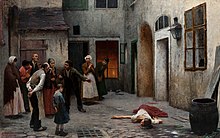
Murder is the unlawful killing of another human without justification or valid alibi, specially the unlawful killing of another human with malice aforethought.[1] [2] [iii] This state of mind may, depending upon the jurisdiction, distinguish murder from other forms of unlawful homicide, such as manslaughter. Manslaughter is killing committed in the absence of malice,[notation 1] brought about by reasonable provocation, or macerated capacity. Involuntary manslaughter, where it is recognized, is a killing that lacks all simply the near attenuated guilty intent, recklessness.
Most societies consider murder to be an extremely serious criminal offence, and thus that a person convicted of murder should receive harsh punishments for the purposes of retribution, deterrence, rehabilitation, or incapacitation. In nearly countries, a person convicted of murder more often than not faces a long-term prison sentence, a life sentence, or death penalty.[4]
Etymology [edit]
The modern English give-and-take "murder" descends from the Proto-Indo-European *mŕ̥-trom which meant "killing", a noun derived from *mer- "to die".[v]
Proto-Germanic in fact had two nouns derived from this word, afterwards merging into the mod English noun: *murþrą "decease, killing, murder" (direct from Proto-Indo-European*mŕ̥-trom), whence Quondam English morðor "cloak-and-dagger or unlawful killing of a person, murder; mortal sin, criminal offense; punishment, torment, misery";[6] and *murþrijô "murderer; homicide" (from the verb *murþrijaną "to murder"), giving Old English language myrþra "homicide, murder; murderer". There was a tertiary word for "murder" in Proto-Germanic, standing Proto-Indo-European *mr̥tós "dead" (compare Latin mors), giving Proto-Germanic *murþą "decease, killing, murder" and Old English morþ "death, crime, murder" (compare German Mord).
The -d- commencement attested in Centre English mordre, mourdre, murder, murdre could accept been influenced by Sometime French murdre, itself derived from the Germanic noun via Frankish *murþra (compare Onetime Loftier German murdreo, murdiro), though the same sound development can be seen with burden (from burthen). The alternative murther (attested up to the 19th century) springs directly from the Old English forms. Eye English mordre is a verb from Anglo-Saxon myrðrian from Proto-Germanic *murþrijaną, or, according to the Oxford English Lexicon, from the noun.[7]
Use of the term [edit]
In many countries, in news reports, out of business organization for being accused of defamation,[8] journalists are generally conscientious not to identify a suspect as a murderer until the suspect is convicted of murder in a courtroom of law. Afterwards abort, for case, journalists may instead write that the person was "arrested on suspicion of murder",[nine] or, after a prosecutor files charges, as an "accused murderer".[10]
Opponents of ballgame consider abortion a form of murder.[11] [12] In some countries, a fetus is a legal person who tin can be murdered, and killing a meaning woman is considered a double homicide.[xiii] [xiv]
Definition [edit]
The eighteenth-century English jurist William Blackstone (citing Edward Coke), in his Commentaries on the Laws of England set out the common police definition of murder, which by this definition occurs
when a person, of sound memory and discretion, unlawfully kills any reasonable creature in beingness and under the rex's peace, with malice aforethought, either express or unsaid.[xv]
The elements of common law murder are:
- unlawful
- killing
- through criminal act or omission
- of a human
- by some other man
- with malice aforethought.[16]
- Unlawful – This distinguishes murder from killings that are done inside the boundaries of law, such as death penalty, justified self-defense, or the killing of enemy combatants by lawful combatants every bit well as causing collateral damage to not-combatants during a state of war.[17]
- Killing – At common law life ended with cardiopulmonary arrest[16] – the total and irreversible cessation of claret circulation and respiration.[16] With advances in medical engineering science courts accept adopted irreversible abeyance of all brain part as marker the finish of life.[sixteen]
- Criminal act or omission – Killing can be committed past an act or an omission.[18]
- Of a human – This element presents the issue of when life begins. At common law, a fetus was not a human being.[19] Life began when the fetus passed through the vagina and took its first breath.[16]
- By another human – In early on mutual police, suicide was considered murder.[16] The requirement that the person killed be someone other than the perpetrator excluded suicide from the definition of murder.
- With malice aforethought – Originally malice aforethought carried its everyday meaning – a deliberate and premeditated (prior intent) killing of some other motivated by ill will. Murder necessarily required that an appreciable time laissez passer between the formation and execution of the intent to kill. The courts broadened the scope of murder past eliminating the requirement of actual premeditation and deliberation equally well equally true malice. All that was required for malice aforethought to exist is that the perpetrator human activity with 1 of the four states of mind that constitutes "malice".
The four states of mind recognized as constituting "malice" are:[20]
- Intent to impale,
- Intent to inflict grievous actual damage short of expiry,
- Reckless indifference to an unjustifiably high risk to human life (sometimes described as an "abandoned and malignant middle"), or
- Intent to commit a unsafe felony (the "felony murder" doctrine).
Under state of mind (i), intent to impale, the deadly weapon rule applies. Thus, if the defendant intentionally uses a deadly weapon or instrument against the victim, such apply authorizes a permissive inference of intent to impale. Examples of deadly weapons and instruments include but are not express to guns, knives, deadly toxins or chemicals or gases and even vehicles when intentionally used to harm i or more victims.
Nether state of mind (iii), an "abased and cancerous eye", the killing must result from the defendant's acquit involving a reckless indifference to man life and a witting disregard of an unreasonable chance of death or serious bodily injury. In Australian jurisdictions, the unreasonable chance must amount to a foreseen probability of death (or grievous bodily harm in nearly states), every bit opposed to possibility.[21]
Under state of mind (iv), the felony-murder doctrine, the felony committed must exist an inherently dangerous felony, such equally burglary, arson, rape, robbery or kidnapping. Importantly, the underlying felony cannot be a bottom included offense such as set on, otherwise all criminal homicides would be murder as all are felonies.
In Spanish criminal law, murder takes place when any of these requirements concur: Treachery (the use of means to avoid risk for the assaulter or to ensure that the crime goes unpunished), cost or reward (financial gain) or viciousness (deliberately increasing the pain of the victim). After the terminal reform of the Spanish Criminal Code, in strength since July ane, 2015, another circumstance that turns homicide into murder is the desire to facilitate the commission of some other law-breaking or to preclude it from being discovered.[22]
Equally with most legal terms, the precise definition of murder varies betwixt jurisdictions and is usually codification in some grade of legislation. Fifty-fifty when the legal distinction between murder and manslaughter is articulate, information technology is not unknown for a jury to find a murder defendant guilty of the lesser offense. The jury might sympathize with the defendant (due east.g. in a crime of passion, or in the example of a bullied victim who kills their tormentor), and the jury may wish to protect the accused from a judgement of life imprisonment or execution.
Degrees of murder [edit]
Some jurisdictions divide murder past degrees. The distinction between kickoff- and second-degree murder exists, for case, in Canadian murder law and U.Southward. murder law.
The most common division is between starting time- and 2nd-degree murder. By and large, 2nd-degree murder is common police murder, and first-degree is an aggravated form. The aggravating factors of first-degree murder depend on the jurisdiction, only may include a specific intent to impale, premeditation, or deliberation. In some, murders committed by acts such as strangulation, poisoning, or lying in wait are also treated equally showtime-degree murder.[23] A few states in the U.S. further distinguish third-degree murder, merely they differ significantly in which kinds of murders they classify as second-degree versus tertiary-caste. For case, Minnesota defines third-degree murder as depraved-heart murder, whereas Florida defines tertiary-degree murder equally felony murder (except when the underlying felony is specifically listed in the definition of first-degree murder).[24] [25]
Some jurisdictions as well distinguish premeditated murder. This is the crime of wrongfully and intentionally causing the expiry of another homo being (too known as murder) afterwards rationally considering the timing or method of doing so, in order to either increase the likelihood of success, or to evade detection or apprehension.[26] Land laws in the United States vary as to definitions of "premeditation". In some states, premeditation may exist construed as taking place mere seconds before the murder. Premeditated murder is one of the virtually serious forms of homicide, and is punished more severely than manslaughter or other types of homicide, oftentimes with a life judgement without the possibility of parole, or in some countries, the death sentence. In the U.S, federal law () criminalizes premeditated murder, felony murder and second-degree murder committed under situations where federal jurisdiction applies.[27] In Canada, the criminal code classifies murder as either commencement- or second-caste. The former type of murder is often chosen premeditated murder, although premeditation is not the only way murder can be classified equally commencement-degree.
Common law [edit]
According to Blackstone, English common law identified murder every bit a public wrong.[28] According to common police, murder is considered to be malum in se, that is, an deed which is evil within itself. An act such as murder is wrong or evil by its very nature,[ citation needed ] and information technology is the very nature of the act which does non require any specific detailing or definition in the law to consider murder a crime.[29]
Some jurisdictions still have a common law view of murder. In such jurisdictions, what is considered to be murder is defined by precedent instance law or previous decisions of the courts of police. Yet, although the mutual law is by nature flexible and adaptable, in the interests both of certainty and of securing convictions, nigh common police jurisdictions have codified their criminal law and at present take statutory definitions of murder.
Exclusions [edit]
General [edit]
Although laws vary by country, there are circumstances of exclusion that are mutual in many legal systems.
- The killing of enemy combatants who have not surrendered, when committed by lawful combatants in accord with lawful orders in state of war, is generally not considered murder. Illicit killings inside a state of war may constitute murder or homicidal state of war crimes; see Laws of war.
- Self-defence force: acting in self-defense or in defense of another person is mostly accepted every bit legal justification for killing a person in situations that would otherwise have been murder. However, a self-defence force killing might be considered manslaughter if the killer established control of the situation before the killing took place. In the example of self-defence force, it is called a "justifiable homicide".[30]
- Unlawful killings without malice or intent are considered manslaughter.
- In many common law countries, provocation is a partial defence force to a charge of murder which acts by converting what would otherwise take been murder into manslaughter (this is voluntary manslaughter, which is more than astringent than involuntary manslaughter).
- Accidental killings are considered homicides. Depending on the circumstances, these may or may non be considered criminal offenses; they are oftentimes considered manslaughter.
- Suicide does non constitute murder in well-nigh societies. Assisting a suicide, all the same, may be considered murder in some circumstances.
Specific to certain countries [edit]
- Capital penalty: some countries practice the death sentence. Death penalty may exist ordered by a legitimate court of law as the result of a conviction in a criminal trial with due process for a serious crime. The 47 member states of the Council of Europe are prohibited from using the death penalty.
- Euthanasia, dr.-assisted suicide: the administration of lethal drugs by a medico to a terminally ill patient, if the intention is solely to convalesce pain, in many jurisdictions it is seen as a special case (run across the doctrine of double effect and the example of Dr John Bodkin Adams).[31]
- Killing to forestall the theft of 1'south belongings may be legal, depending on the jurisdiction.[32] [33] In 2013, a jury in south Texas acquitted a man who killed a sex worker who attempted to run abroad with his money.[34]
- Killing an intruder who is plant by an owner to be in the possessor's home (having entered unlawfully): legal in most US states (come across Castle doctrine).[35]
- Killing to forbid specific forms of aggravated rape or sexual assault – killing of attacker by the potential victim or past witnesses to the scene; legal in parts of the United states of america and in diverse other countries.[36]
- In some countries, the killing of a woman or girl in specific circumstances (e.g., when she commits adultery and is killed by her husband or other family members, known as honour killing) is not considered murder.[37]
- In the United States, in some states and in federal jurisdiction, a killing by a police officer is excluded from prosecution if the officer believes they are beingness threatened with mortiferous forcefulness past the victim. This may include such actions past the victim as reaching into a glove compartment or pocket for license and registration, if the officer thinks that the victim might be reaching for a gun.[38]
Victim [edit]
All jurisdictions crave that the victim be a natural person; that is, a human being beingness who was nevertheless alive before being murdered. In other words, under the law 1 cannot murder a corpse, a corporation, a non-man animal, or whatever other non-human organism such every bit a plant or bacterium.
California's murder statute, penal code section 187, expressly mentioned a fetus every bit being capable of beingness killed, and was interpreted by the Supreme Court of California in 1994 as not requiring any proof of the viability of the fetus as a prerequisite to a murder conviction.[39] This property has two implications. Firstly, a defendant in California tin can be convicted of murder for killing a fetus which the female parent herself could have terminated without committing a law-breaking.[39] And secondly, as stated by Justice Stanley Mosk in his dissent, because women carrying nonviable fetuses may not exist visibly pregnant, it may be possible for a accused to be convicted of intentionally murdering a person they did not know existed.[39]
Mitigating circumstances [edit]
Some countries allow weather condition that "touch on the residual of the mind" to be regarded as mitigating circumstances. This ways that a person may be found guilty of "manslaughter" on the basis of "diminished responsibility" rather than being plant guilty of murder, if it tin be proved that the killer was suffering from a condition that affected their judgment at the time. Depression, post-traumatic stress disorder and medication side-effects are examples of conditions that may be taken into account when assessing responsibility.
Insanity [edit]
Mental disorder may use to a broad range of disorders including psychosis acquired past schizophrenia and dementia, and alibi the person from the need to undergo the stress of a trial equally to liability. Unremarkably, sociopathy and other personality disorders are not legally considered insanity, because of the belief they are the result of free will in many societies. In some jurisdictions, following the pre-trial hearing to determine the extent of the disorder, the defense of "not guilty by reason of insanity" may be used to get a non guilty verdict.[40] This defense has ii elements:
- That the defendant had a serious mental illness, affliction, or defect
- That the accused'southward mental status, at the time of the killing, rendered the perpetrator unable to determine right from wrong, or that what they were doing was wrong
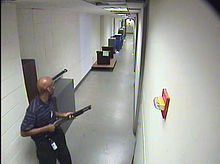
Under New York law, for example:
§ 40.15 Mental disease or defect. In any prosecution for an criminal offence, information technology is an affirmative defence that when the defendant engaged in the proscribed behave, he lacked criminal responsibility by reason of mental disease or defect. Such lack of criminal responsibility means that at the time of such conduct, as a consequence of mental disease or defect, he lacked substantial capacity to know or appreciate either: i. The nature and consequences of such conduct; or 2. That such deport was incorrect.
Under the French Penal Code:
Article 122-1
- A person is non criminally liable who, when the act was committed, was suffering from a psychological or neuropsychological disorder which destroyed his discernment or his ability to command his actions.
- A person who, at the fourth dimension he acted, was suffering from a psychological or neuropsychological disorder which reduced his discernment or impeded his power to control his actions, remains punishable; still, the court shall take this into account when it decides the penalisation and determines its authorities.
Those who successfully argue a defense based on a mental disorder are unremarkably referred to mandatory clinical treatment until they are certified prophylactic to exist released back into the community, rather than prison.[42] A criminal defendant is ofttimes presented with the pick of pleading "not guilty by reason of insanity". Thus, a finding of insanity results in a non-guilty verdict, although the defendant is placed in a state handling facility where they could be kept for years or fifty-fifty decades.[43]
Postpartum depression [edit]
Postpartum depression (likewise known as post-natal depression) is recognized in some countries as a mitigating gene in cases of infanticide. According to Susan Friedman, "Two dozen nations accept infanticide laws that decrease the penalty for mothers who kill their children of up to one twelvemonth of historic period. The United States does not have such a law, simply mentally ill mothers may plead not guilty by reason of insanity."[44] In the constabulary of the Commonwealth of Ireland, infanticide was fabricated a split offense from murder in 1949, applicable for the mother of a baby under 1 twelvemonth erstwhile where "the balance of her mind was disturbed by reason of her not having fully recovered from the result of giving nascency to the child or by reason of the outcome of lactation consistent upon the nascency of the child".[45] Since independence, death sentences for murder in such cases had always been commuted;[46] the new deed was intended "to eliminate all the terrible ritual of the black cap and the solemn words of the judge pronouncing judgement of expiry in those cases ... where information technology is clear to the Courtroom and to everybody, except perhaps the unfortunate accused, that the sentence will never be carried out."[47] In Russia, murder of a newborn child by the female parent has been a separate crime since 1996.[48]
Unintentional [edit]
For a killing to exist considered murder in ix out of 50 states in the US, there ordinarily needs to exist an element of intent. A defendant may argue that they took precautions not to kill, that the death could non have been anticipated, or was unavoidable. As a general dominion, manslaughter[49] constitutes reckless killing, but manslaughter as well includes criminally negligent (i.eastward. grossly negligent) homicide.[fifty] Unintentional killing that results from an involuntary activeness generally cannot institute murder.[51] Afterward examining the evidence, a approximate or jury (depending on the jurisdiction) would decide whether the killing was intentional or unintentional.
Diminished capacity [edit]
In jurisdictions using the Uniform Penal Code, such equally California, diminished chapters may exist a defense. For example, Dan White used this defence[52] to obtain a manslaughter conviction, instead of murder, in the assassination of Mayor George Moscone and Supervisor Harvey Milk. Afterward, California amended its penal code to provide "As a matter of public policy at that place shall be no defence force of diminished capacity, diminished responsibleness, or irresistible impulse in a criminal action...."[53]
Aggravating circumstances [edit]
Murder with specified aggravating circumstances is ofttimes punished more harshly. Depending on the jurisdiction, such circumstances may include:
- Premeditation
- Poisoning
- Murder of a child
- Murder of a law officer,[54] [55] judge, firewoman or witness to a crime[56]
- Murder of a pregnant woman[57]
- Law-breaking committed for pay or other advantage, such every bit contract killing[58]
- Exceptional brutality or cruelty
- Methods which are unsafe to the public,[59] e.g. explosion, arson, shooting in a oversupply etc.[60]
- Murder for a political cause[54] [61]
- Murder committed in lodge to muffle another crime or facilitate its commission.[62]
- Detest crimes, which occur when a perpetrator targets a victim because of their perceived membership in a certain social group.
- Treachery (e.g. Heimtücke in German law)
In the United States[63] and Canada,[64] these murders are referred to as first-degree or aggravated murders. Murder, nether English criminal law, always carries a mandatory life sentence, but is not classified into degrees. Penalties for murder committed under aggravating circumstances are often higher, nether English language constabulary, than the 15-year minimum not-parole menses that otherwise serves as a starting signal for a murder committed by an adult.
Felony murder rule [edit]
A legal doctrine in some common law jurisdictions broadens the criminal offence of murder: when an offender kills in the commission of a unsafe crime, (regardless of intent), he or she is guilty of murder. The felony murder rule is often justified past its supporters as a means of preventing dangerous felonies,[65] just the case of Ryan Holle[66] shows it can be used very widely.
Year-and-a-twenty-four hour period dominion [edit]
In some common police force jurisdictions, a accused accused of murder is non guilty if the victim survives for longer than 1 yr and ane twenty-four hours after the assail.[67] This reflects the likelihood that if the victim dies, other factors will have contributed to the cause of death, breaking the chain of causation; and also ways that the responsible person does not have a charge of murder "hanging over their head indefinitely".[68] Subject to whatsoever statute of limitations, the defendant could nonetheless be charged with an criminal offence reflecting the seriousness of the initial assault.
With advances in modernistic medicine, well-nigh countries have abased a fixed fourth dimension menses and test causation on the facts of the instance. This is known as "delayed death" and cases where this was applied or was attempted to exist applied go back to at least 1966.[69]
In England and Wales, the "year-and-a-day dominion" was abolished by the Law Reform (Yr and a Mean solar day Rule) Act 1996. However, if death occurs three years or more afterwards the original attack and so prosecution can take place simply with the attorney-full general'due south approval.
In the United States, many jurisdictions have abolished the rule as well.[seventy] [71] Abolition of the dominion has been accomplished past enactment of statutory criminal codes, which had the event of displacing the common-law definitions of crimes and corresponding defenses. In 2001 the Supreme Court of the Us held that retroactive application of a state supreme court decision abolishing the twelvemonth-and-a-day rule did non violate the Ex Post Facto Clause of Article I of the U.s. Constitution.[72]
The potential outcome of fully abolishing the dominion tin can be seen in the case of 74-twelvemonth-old William Barnes, charged with the murder of a Philadelphia law officer Walter T. Barclay Jr., who he had shot nearly 41 years previously. Barnes had served 16 years in prison house for attempting to murder Barkley, but when the policeman died on Baronial nineteen, 2007, this was alleged to exist from complications of the wounds suffered from the shooting – and Barnes was charged with his murder. He was acquitted on May 24, 2010.[73]
Contributing factors [edit]
According to Morall, the motivations for murder fit into the following 4 categories:[74]
- Lust: The murderer seeks to kill rivals to obtain objects of their sexual desire
- Love: The murderer seeks to "mercy kill" a loved one with a major deformity or an incurable illness.
- Loathing: The murderer seeks to impale a loathed person (such as an calumniating parent) or members of a loathed group or civilisation.
- Boodle: The murderer seeks some form of financial gain.
Morall argues that a motive lonely is insufficient to explain criminal killing, as people can feel those impulse without killing. Morall insists risk factors that may increase the take chances that somebody volition commit a murder include:[74]
- Testosterone, the primary male sex hormone, is correlated with competitive and assertive behaviour.
- Reduction in serotonin increases likelihood of impulsive hostile behaviour.
- Alteration in the breakdown of glucose appears to affect mood and behaviour.
- Hyperglycemia and Hypoglycemia can both lead to aggression.
- Consumption of booze can lead to reduced self control.
- Environmental pollutants circulating in the body are linked to heightened assailment.
- Malnutrition from eating besides much junk food tin provoke aggressive behaviour and even murder.
Certain personality disorders are associated with an increased homicide rate, most notably egotistic, anti-social, and histrionic personality disorders and those associated with psychopathology.[75]
Some aspects of homicides, including the genetic relations or proximity betwixt murderers and their victims, (as in the Cinderella outcome), may potentially be explained by the evolution theory or evolutionary psychology.[76]
Several studies have shown that there is a correlation between murder rates and poverty.[77] [78] [79] [80] A 2000 report showed that regions of the state of São Paulo in Brazil with lower income as well had college rates of murder.[80]
Religious attitudes [edit]
Abrahamic context [edit]

A group of Thugs strangling a traveller on a highway in the early 19th century.
In the Abrahamic religions, the first ever murder was committed by Cain against his brother Abel out of jealousy.[81] In the past, certain types of homicide were lawful and justified. Georg Oesterdiekhoff wrote:
Evans-Pritchard says almost the Nuer from Sudan: "Homicide is not forbidden, and Nuer do not think it incorrect to impale a man in off-white fight. On the contrary, a man who slays some other in combat is admired for his courage and skill." (Evans-Pritchard 1956: 195) This statement is true for virtually African tribes, for pre-modern Europeans, for Indigenous Australians, and for Native Americans, according to ethnographic reports from all over the world. ... Homicides rise to incredible numbers amid headhunter cultures such as the Papua. When a boy is built-in, the father has to impale a man. He needs a proper name for his child and can receive it only by a human, he himself has murdered. When a human wants to marry, he must kill a man. When a homo dies, his family again has to kill a man.[82]
In many such societies the redress was not via a legal system, only by claret revenge, although at that place might also exist a form of payment that could be made instead—such as the weregild which in early Germanic society could be paid to the victim'due south family in lieu of their correct of revenge.
One of the oldest-known prohibitions confronting murder appears in the Sumerian Code of Ur-Nammu written sometime between 2100 and 2050 BC. The lawmaking states, "If a man commits a murder, that human being must be killed."
Judeo-Christian standard [edit]
In Judeo-Christian traditions, the prohibition confronting murder is one of the Ten Commandments given by God to Moses in (Exodus: 20v13) and (Deuteronomy 5v17). The Vulgate and subsequent early English translations of the Bible used the term secretly killeth his neighbour or smiteth his neighbor secretly rather than murder for the Latin clam percusserit proximum.[83] [84] Afterward editions such every bit Immature's Literal Translation and the World English Bible have translated the Latin occides simply as murder [85] [86] rather than the alternatives of kill, assassinate, fall upon, or slay.
In Islam [edit]
In Islam according to the Qur'an, ane of the greatest sins is to kill a human being who has committed no fault.[87]
"Do non take a ˹human being˺ life—fabricated sacred by Allah—except with ˹legal˺ correct." [Quran 17:33]
"That is why We ordained for the Children of State of israel that whoever takes a life—unless as a punishment for murder or mischief in the country—it will be as if they killed all of humanity; and whoever saves a life, it will exist as if they saved all of humanity." [Quran 5:32]
"˹They are˺ those who do not invoke any other god likewise Allah, nor take a ˹human˺ life—made sacred by Allah—except with ˹legal˺ right,i nor commit fornication. And whoever does ˹any of˺ this will face the penalty." [Quran 25:68]
Historical attitudes [edit]
The term assassin derives from Hashshashin,[88] a militant Ismaili Shi'ite sect, active from the 8th to 14th centuries. This mystic secret gild killed members of the Abbasid, Fatimid, Seljuq and Crusader elite for political and religious reasons.[89] The Thuggee cult that plagued India was devoted to Kali, the goddess of expiry and destruction.[90] [91] According to some estimates the Thuggees murdered 1 1000000 people betwixt 1740 and 1840.[92] The Aztecs believed that without regular offerings of blood the lord's day god Huitzilopochtli would withdraw his support for them and destroy the world every bit they knew it.[93] According to Ross Hassig, author of Aztec Warfare, "between 10,000 and lxxx,400 persons" were sacrificed in the 1487 re-consecration of the Groovy Pyramid of Tenochtitlan.[94] [95]
Slavery [edit]
Southern slave codes did make willful killing of a slave illegal in most cases.[96] For case, the 1860 Mississippi example of Oliver v. State charged the defendant with murdering his own slave.[97] In 1811, the wealthy white planter Arthur Hodge was hanged for murdering several of his slaves on his plantation in the Virgin Islands.[98]
Award killings in Corsica [edit]
In Corsica, vendetta was a social code that required Corsicans to kill anyone who wronged their family award. Betwixt 1821 and 1852, no fewer than 4,300 murders were perpetrated in Corsica.[99]
Incidence [edit]
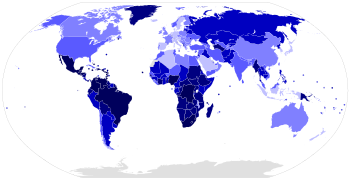
International murder rate per 100,000 inhabitants, 2011
0–ane
1–2
2–five
five–10
10–20
>xx
The Globe Health Organization reported in October 2002 that a person is murdered every 60 seconds.[100] An estimated 520,000 people were murdered in 2000 around the globe. Another study estimated the worldwide murder rate at 456,300 in 2010 with a 35% increase since 1990.[101] Two-fifths of them were immature people between the ages of 10 and 29 who were killed by other young people.[102] Considering murder is the least likely crime to go unreported, statistics of murder are seen as a bellwether of overall crime rates.[103]
Murder rates vary greatly among countries and societies around the world. In the Western world, murder rates in nigh countries have declined significantly during the 20th century and are now between 1 and 4 cases per 100,000 people per year. Latin America and the Caribbean, the region with the highest murder rate in the globe,[104] experienced more than 2.five one thousand thousand murders between 2000 and 2017.[105]

UNODC : Per 100,000 population (2011)
Murder rates by varies countries [edit]
Murder rates in jurisdictions such as Japan, Singapore, Hong Kong, Iceland, Switzerland, Italy, Spain and Deutschland are among the everyman in the world, around 0.3–i cases per 100,000 people per year; the rate of the United States is among the highest of developed countries, effectually 4.5 in 2014,[106] with rates in larger cities sometimes over twoscore per 100,000.[107] The top x highest murder rates are in Republic of honduras (91.6 per 100,000), El Salvador, Cote d'ivoire, Venezuela, Belize, Jamaica, U.Southward. Virgin Islands, Republic of guatemala, Saint Kitts and Nevis and Zambia. (UNODC, 2011 – full table here).
The following absolute murder counts per-country are non comparable considering they are not adjusted by each state's full population. Nonetheless, they are included here for reference, with 2010 used as the base year (they may or may not include justifiable homicide, depending on the jurisdiction). At that place were 52,260 murders in Brazil, consecutively elevating the record set in 2009.[108] Over one-half a 1000000 people were shot to expiry in Brazil betwixt 1979 and 2003.[109] 33,335 murder cases were registered beyond India,[110] approximately 17,000 murders in Colombia (the murder rate was 38 per 100,000 people, in 2008 murders went down to fifteen,000),[111] approximately 16,000 murders in S Africa,[112] approximately 15,000 murders in the Usa,[113] approximately 26,000 murders in Mexico,[114] nigh 8,000 murders committed in Russian federation,[115] approximately 13,000 murders in Venezuela,[116] approximately 4,000 murders in El Salvador,[117] approximately ane,400 murders in Jamaica,[118] approximately 550 murders in Canada[119] and approximately 470 murders in Trinidad and Tobago.[118] Pakistan reported 12,580 murders.[120]
Murder in the Us [edit]

Lake Bodom murders in Espoo, Finland is the most famous unsolved homicide cases in Finnish criminal history.[121] The tent is investigated immediately later on the murders in 1960.

The scene of a murder in Rio de Janeiro. More than than 800,000 people were murdered in Brazil between 1980 and 2004.[122]
In the United States, 666,160 people were killed between 1960 and 1996.[123] Approximately xc% of murders in the US are committed by males.[124] Between 1976 and 2005, 23.5% of all murder victims and 64.8% of victims murdered past intimate partners were female.[125] For women in the U.s., homicide is the leading cause of expiry in the workplace.[126]
In the US, murder is the leading cause of expiry for African American males aged 15 to 34. Between 1976 and 2008, African Americans were victims of 329,825 homicides.[127] [128] In 2006, Federal Agency of Investigation'due south Supplementary Homicide Report indicated that well-nigh half of the fourteen,990 murder victims that yr were Black (7421).[129] In the year 2007, there were 3,221 blackness victims and three,587 white victims of not-negligent homicides. While 2,905 of the blackness victims were killed past a black offender, 2,918 of the white victims were killed by white offenders. In that location were 566 white victims of blackness offenders and 245 black victims of white offenders.[130] The "white" category in the Compatible Criminal offence Reports (UCR) includes non-black Hispanics.[131] Murder demographics are affected by the improvement of trauma intendance, which has resulted in reduced lethality of tearing assaults – thus the murder rate may not necessarily indicate the overall level of social violence.[132]
Workplace homicide, which tripled during the 1980s, is the fastest growing category of murder in America.[126] [133] [134]
Development of murder rates over time in dissimilar countries is oftentimes used past both supporters and opponents of capital penalty and gun control. Using properly filtered information, it is possible to make the instance for or against either of these issues. For example, one could look at murder rates in the The states from 1950 to 2000,[135] and notice that those rates went up sharply shortly after a moratorium on decease sentences was effectively imposed in the late 1960s. This fact has been used to contend that death penalty serves as a deterrent and, as such, it is morally justified. Death penalty opponents frequently counter that the United States has much higher murder rates than Canada and most European Matrimony countries, although all those countries have abolished the death penalty. Overall, the global pattern is too circuitous, and on average, the influence of both these factors may not be pregnant and could be more than social, economic, and cultural.
Despite the immense improvements in forensics in the by few decades, the fraction of murders solved has decreased in the United States, from 90% in 1960 to 61% in 2007.[136] Solved murder rates in major U.South. cities varied in 2007 from 36% in Boston, Massachusetts to 76% in San Jose, California.[137] Major factors affecting the arrest charge per unit include witness cooperation[136] and the number of people assigned to investigate the case.[137]
History of murder rates [edit]
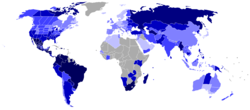
Intentional homicide rate per 100,000 inhabitants, 2009
According to scholar Pieter Spierenburg homicide rates per 100,000 in Europe have fallen over the centuries, from 35 per 100,000 in medieval times, to 20 in 1500 AD, v in 1700, to beneath two per 100,000 in 1900.[138]
In the United States, murder rates take been higher and have fluctuated. They fell below 2 per 100,000 by 1900, rose during the first half of the century, dropped in the years following World War II, and bottomed out at four.0 in 1957 before rise again.[139] The rate stayed in 9 to 10 range most of the period from 1972 to 1994, before falling to 5 in present times.[138] The increment since 1957 would accept been even greater if not for the significant improvements in medical techniques and emergency response times, which mean that more and more attempted homicide victims survive. According to one judge, if the lethality levels of criminal assaults of 1964 still practical in 1993, the country would have seen the murder rate of around 26 per 100,000, almost triple the actually observed rate of 9.5 per 100,000.[132]

The historical homicide charge per unit in Stockholm since 1400 AD. The murder rate was very high in the Center Ages. The rate has declined greatly: from 45/100,000 to a low of 0.half dozen in the 1950s. The last decades have seen the homicide charge per unit rise slowly.
A like, but less pronounced blueprint has been seen in major European countries as well. The murder rate in the United kingdom of great britain and northern ireland barbarous to 1 per 100,000 by the commencement of the 20th century and as low as 0.62 per 100,000 in 1960, and was at ane.28 per 100,000 every bit of 2009[update]. The murder rate in France (excluding Corsica) bottomed out after World War Ii at less than 0.4 per 100,000, quadrupling to 1.6 per 100,000 since then.[140]
The specific factors driving this dynamics in murder rates are circuitous and not universally agreed upon. Much of the heighten in the U.S. murder rate during the showtime half of the 20th century is generally thought to be attributed to gang violence associated with Prohibition. Since most murders are committed by immature males, the about simultaneous depression in the murder rates of major developed countries circa 1960 tin can be attributed to low birth rates during the Great Depression and World War Ii. Causes of further moves are more controversial. Some of the more exotic factors claimed to affect murder rates include the availability of ballgame[141] and the likelihood of chronic exposure to lead during childhood (due to the utilize of leaded paint in houses and tetraethyllead every bit a gasoline additive in internal combustion engines).[142]
Investigation [edit]
The success rate of criminal investigations into murders (the clearance rate) tends to be relatively loftier for murder compared to other crimes, due to its seriousness. In the Us, the clearance rate was 62.half dozen% in 2004.
Encounter also [edit]
[edit]
- Lists of murders
- List of types of killing
- Axe murder
- Listing of unsolved deaths
[edit]
- Child murder
- Culpable homicide
- Depraved-heart murder
- Double murder
- Execution-style murder
- Letting die
- Mass murder
- Misdemeanor murder
- Murder conviction without a body
- Vii laws of Noah
- Stigmatized belongings
- Thrill killing
- Majuscule murder
- Assassination, the murder of a prominent person, such as a head of land or head of government.
Murder laws by country [edit]
- Australia
- Brazil
- Canada
- Cathay
- Cuba
- Denmark
- England and Wales
- Finland
- France
- Germany
- Hong Kong
- India
- Israel
- Italy
- Netherlands
- Northern Republic of ireland
- Norway
- Peru
- Portugal
- Romania
- Russia
- Sweden
- Switzerland
- United States
Notes [edit]
- ^ This is "malice" in a technical legal sense, not the more usual English language sense denoting an emotional state. Run into malice (law).
References [edit]
- ^ West's Encyclopedia of American Law Book 7 (Legal Representation to Oyez). West Group. 1997. ISBN978-0314201607 . Retrieved 10 September 2017. ("The unlawful killing of another human being existence without justification or excuse.")
- ^ "Murder". Merriam-Webster. Archived from the original on 2 Oct 2017. Retrieved x September 2017.
- ^ The American Heritage Lexicon (5 ed.). Random House Publishing Group. 2012. ISBN9780553583229 . Retrieved 10 September 2017. ("The killing of some other person without justification or excuse, especially the crime of killing a person with malice aforethought or with recklessness manifesting farthermost indifference to the value of human life.")
- ^ Tran, Marker (2011-03-28). "China and US among acme punishers but decease penalisation in decline". The Guardian. London. Archived from the original on 2017-02-17.
- ^ Bynon, Theodora (1977). Historical Linguistics . Cambridge University Press. ISBN978-0521291880 . Retrieved ten September 2017.
- ^ "Murder", in: Online Etymology Dictionary, accessed on 17 July 2020.
- ^ Nielson, William A.; Patch, Howard R. (1921). Selections from Chaucer. New York: Harcourt, Brace & Co. Retrieved 10 September 2017.
- ^ See, e.g., Goodman, Brenda (27 May 2006). "Falsely Accused Suspect Pursues Libel Case". New York times. Archived from the original on four Baronial 2019. Retrieved 4 August 2019.
- ^ Fisher, Doug (July 1, 2003). "Getting a hand upward on court, criminal offense terms". Mutual Sense Journalism. Archived from the original on June 24, 2016. Retrieved October 3, 2016.
- ^ "Charges & Allegations". new script.com. Archived from the original on June three, 2016. Retrieved Oct 2, 2016.
- ^ Marquis, Don. "An Argument That Abortion Is Wrong". spider web.csulb.edu.
- ^ Stoltzfus, Abby (6 Nov 2019). "Crossfire: Abortion should be illegal". Daily American. Archived from the original on 6 Nov 2019.
- ^ "Is killing a significant adult female a case of double homicide?". The Star . Retrieved 2020-09-13 .
- ^ Text of Unborn Victims of Violence Act Archived 2012-01-06 at the Wayback Machine.
- ^ Blackstone, William (1765). Blackstone's Commentaries on the Laws of England. Avalon Project, Yale Law School. Archived from the original on 2011-08-x. Volume the 4th – Chapter the Fourteenth : Of Homicide.
- ^ a b c d e f Joshua Dressler (2001). Understanding Criminal Law (tertiary ed.). Lexis. ISBN978-0-8205-5027-5.
- ^ Dennis J. Baker (2012). "Affiliate 11". Glanville Williams Textbook of Criminal Constabulary. London.
- ^ Ashford, Elizabeth. "Killing & Letting Die". Philosophy 4826, Life and Decease. Academy of St. Andrews. Archived from the original on 2 February 2017. Retrieved 10 September 2017.
- ^ R v Tait [1990] 1 QB 290.
- ^ Wise, Edward. "Criminal Law" in Introduction to the Law of the United states (Clark and Ansay, eds.), 154 Archived 2015-05-17 at the Wayback Machine (2002).
- ^ R v Crabbe [1985] HCA 22, (1985) 156 CLR 464 (26 March 1985), Loftier Court; but the common police has been modified in NSW: Royall five R [1991] HCA 27, (1991) 172 CLR 378 (25 June 1991), Loftier Court.
- ^ "Ley Orgánica 1/2015, de 30 de marzo, por la que se modifica la Ley Orgánica 10/1995, de 23 de noviembre, del Código Penal". Noticias Jurídicas (in Castilian).
- ^ Murder in the First and Second Degree (14–17) A murder which shall be perpetrated past ... poison, lying in wait, imprisonment, starving, torture, or by any other kind of willful, deliberate and premeditated killing or which shall be committed in the perpetration or attempted perpetration of any arson, rape or sex activity criminal offence, robbery, kidnapping, burglary, or other felony committed or attempted with the use of a deadly weapon, shall be ... murder in the first degree ... and shall be punished past death or life imprisonment ... except that any person ... under 17 years of age at the time of the murder shall be punished with imprisonment ... for life. All other kinds of murder, including that which shall exist proximately caused by the unlawful distribution of opium or whatsoever synthetic or natural salt, compound, derivative, or the preparation of opium ... cause the death of the user, shall be ... murder in the second degree and ... shall be punished equally a Class C felony
- ^ Brenner, Frank (1953). "The Impulsive Murder and the Degree Device". Fordham Law Review. 22 (3). Archived from the original on 2018-03-thirteen. Retrieved 2018-03-13 .
- ^ "Minnesota Second-Degree Murder". findlaw.com. Archived from the original on 2018-03-fourteen. Retrieved 2018-03-xiii .
- ^ "Premeditation". Merriam-Webster. Archived from the original on 10 September 2017. Retrieved ten September 2017.
- ^ "Championship 18 USC, Sec. 1111, Murder". Legal Information Found. Cornell Law School. Archived from the original on 10 September 2017. Retrieved 10 September 2017.
- ^ "Blackstone, Book 4, Chapter 14". Yale.edu. Archived from the original on 2010-12-03. Retrieved 2010-06-25 .
- ^ A Lexicon of Modernistic Legal Usage By Bryan A. Garner, p. 545.
- ^ The French Parliament. "Commodity 122-5". French Criminal Law (in French). Legifrance. Archived from the original on 2008-04-08. Retrieved 2007-11-01 .
- ^ Otlowski, Margaret (1997). Margaret Otlowski, Voluntary Euthanasia and the Common Law, Oxford University Press, 1997, pp. 175–177. ISBN978-0-19-825996-ane . Retrieved 2010-06-25 .
- ^ "Man Kills Suspected Intruders While Protecting Neighbor'south Property". ABC News. Archived from the original on 2014-10-xviii. Retrieved 2014-10-23 .
- ^ see Joe Horn shooting controversy
- ^ "Texas human being acquitted of killing Craigslist escort". Yahoo News. 7 June 2013. Archived from the original on xviii October 2014. Retrieved 2014-10-23 .
- ^ "Assembly, No. 159, State of New Jersey, 213th Legislature, The "New Bailiwick of jersey Self Defense Law"" (PDF). May 6, 2008. Archived (PDF) from the original on September two, 2012. Retrieved 2017-10-03 .
- ^ "v". Criminal Law. University of Minnesota: University of Minnesota Libraries Publishing. 2015. ISBN978-one-946135-08-7. Archived from the original on 2018-01-30.
- ^ "Introduction - Preliminary Examination of then-chosen honor killings in canada". 24 September 2013.
- ^ Joseph Goldstein (July 28, 2016). "Is a Police Shooting a Offense? Information technology Depends on the Officer's Betoken of View". The New York Times. Archived from the original on August 1, 2016. Retrieved July 29, 2016.
The longstanding official deference to the viewpoint of police force officers is enshrined in the laws of some states and Supreme Court rulings.
- ^ a b c People five. Davis, vii Cal. 4th 797, 30 Cal. Rptr. 2nd 50, 872 P.2nd 591 Archived 2015-09-04 at the Wayback Machine (1994).
- ^ M'Naughten'southward case, [1843] All ER Rep 229.
- ^ Northward.Y. Penal Police, § 40.fifteen, plant at Northward.Y. Associates spider web site, retrieved 2014-04-10.
- ^ "Code de la Santé Publique Chapitre 3: Hospitalisation d'office Article L3213-i" (in French). Legifrance. 2002. Archived from the original on 2008-ten-21. Retrieved 2007-10-23 . , note: this text refers to the procedure of involuntary commitment by the need of the public dominance, but the prefect systematically use that procedure whenever a man is discharged due to his dementia.
- ^ "Insanity Defenses – Consequences". Archived from the original on one Baronial 2017. Retrieved 31 July 2017.
- ^ Friedman, SH. "Commentary: Postpartum Psychosis, Infanticide, and Insanity Implications for Forensic Psychiatry", J Am Acad Psychiatry Constabulary forty:three:326-332 (September 2012).
- ^ "Infanticide Act, 1949, Section 1". Irish Statute Volume. Archived from the original on 1 June 2016. Retrieved 22 May 2016.
- ^ Rattigan, Clíona (2008). "'Done to decease by father or relatives': Irish families and infanticide cases, 1922–1950". The History of the Family. 13 (four): 370–383. doi:10.1016/j.hisfam.2008.09.003. ISSN 1081-602X. S2CID 144571256.
- ^ "Infanticide Pecker, 1949—2d and Subsequent Stages". Seanad Éireann debates. 7 July 1949. Vol.36 c.1472. Archived from the original on 1 July 2016. Retrieved 22 May 2016.
- ^ Criminal Code of Russia, art.106
- ^ The French Parliament. "Article 222-8". French Criminal Law. Legifrance. Archived from the original on 2007-11-02. Retrieved 2007-11-01 .
- ^ The French Parliament. "Section II – Involuntary Offences Confronting Life". French Criminal Constabulary. Legifrance. Archived from the original on 2007-eleven-02. Retrieved 2007-11-01 .
- ^ Michaels, Alan C. (1985). "Defining Unintended Murder". Columbia Constabulary Review. 85 (iv): 786–811. doi:ten.2307/1122334. JSTOR 1122334.
- ^ The then-chosen "Twinkie defence").
- ^ California Penal Code § 28(b) Archived 2018-04-25 at the Wayback Machine
- ^ a b See Murder (English law).
- ^ Crimes Act 1900 (NSW) south 19B Mandatory life sentences for murder of constabulary officers.
- ^ See Murder (U.s.a. law).
- ^ See Murder (Romanian police force).
- ^ Meet Murder (Brazilian law).
- ^ Criminal Code of Russia fine art.105 p.2"e"
- ^ [1] Archived 2015-10-18 at the Wayback Machine
- ^ "Parole Lath of Ireland". Citizens Data Board. Parole Board of Ireland. Archived from the original on 2014-10-17.
- ^ Criminal Code of Russia fine art.105 p.2"thousand"
- ^ Larson, Aaron (vii October 2016). "What are Homicide and Murder". ExpertLaw. Archived from the original on 10 September 2017. Retrieved 10 September 2017.
- ^ "Classification of murder". Justice Laws Website. Government of Canada. Archived from the original on 25 September 2015. Retrieved 10 September 2017.
- ^ Sidak, J. Gregory (2015). "Two Economical Rationals for Felony Murder" (PDF). Cornell Law Review. 101: 51. Archived (PDF) from the original on 21 October 2016. Retrieved 10 September 2017.
- ^ Liptak, Adam (2007-12-04). "Serving Life for Providing Automobile to Killers". The New York Times. Archived from the original on 2017-09-29.
- ^ See Country 5. Picotte, 2003 WI 42, 261 Wis. 2d 249 (2003)[2](search for "twelvemonth-and-a-day rule")
- ^ "Criminal lawyers dorsum review of fourth dimension limit for homicide charges". Radio NZ. 25 February 2017. Archived from the original on 14 August 2017. Retrieved 14 Baronial 2017.
- ^ Wofford, Taylor (August 9, 2014). "Will John Hinckley Jr. Confront Murder Charges for the 'Delayed Death' of James Brady?". Newsweek. Archived from the original on March 10, 2015. Retrieved 2015-02-28 .
- ^ "People v. Carrillo, 646 North.E.2d 582 (Sick. 1995)". Archived from the original on 2015-09-04. Retrieved 2015-06-14 .
- ^ "Land v. Gabehart, 836 P.2d 102 (N.Grand. 1992)". Archived from the original on 2015-09-04. Retrieved 2015-06-xiv .
- ^ Rogers five. Tennessee, 532 U.S. 451 (2001).
- ^ "Shooter acquitted of murder charge in 1966 shooting of Philadelphia police force officeholder". PA Media Group. Associated Press. 24 May 2010. Archived from the original on x September 2017.
- ^ a b Morrall, Peter (2007). "Murder and society: why commit murder?" (PDF). Centre for Crime and Justice Studies.
- ^ Petherick, Wayne (2018). Homicide. London, United Kingdom. pp. 62–65. ISBN9780128125298.
- ^ Jones, Dan (thirty January 2008). "Man behaviour: Killer instincts". Nature. 451 (7178): 512–515. Bibcode:2008Natur.451..512J. doi:10.1038/451512a. PMID 18235473. S2CID 205035543.
- ^ Dong, Baomin; Egger, Peter H.; Guo, Yibei (2020-05-18). "Is poverty the mother of criminal offense? Evidence from homicide rates in Prc". PLOS 1. 15 (5): e0233034. Bibcode:2020PLoSO..1533034D. doi:ten.1371/journal.pone.0233034. ISSN 1932-6203. PMC7234816. PMID 32422646.
- ^ Bailey, William C. (1984). "Poverty, Inequality, and City Homicide Rates". Criminology. 22 (iv): 531–550. doi:10.1111/j.1745-9125.1984.tb00314.ten. ISSN 1745-9125.
- ^ "Psychosocial Causes of the Crime of Murder in Pakistan". search.proquest.com . Retrieved 2020-08-28 .
- ^ a b "Correlation betwixt homicide rates and economic indicators in Sao Paulo, Brazil, 1996". Revista Panamericana de Salud Pública. 2000.
- ^ Schimmel, Solomon. "Envy in Jewish idea and literature." Envy: Theory and research (2008): 17–38.
- ^ Oesterdiekhoff, Georg (2011). The Steps of Human Towards Civilization. BoD – Books on Demand. pp. 169–170. ISBN978-3-8423-4288-0.
- ^ "Vulgate Deuteronomy Ch27 V24". Latinvulgate.com. Archived from the original on 2010-10-10. Retrieved 2010-06-25 .
- ^ "Parallel Hebrew Old Testament Deuteronomy Ch27 V24". Hebrewoldtestament.com. Archived from the original on 2010-xi-29. Retrieved 2010-06-25 .
- ^ "Exodus 20v13". Immature's Literal Translation. Archived from the original on 2011-04-26. Retrieved 2011-01-21 .
Yard dost not murder.
- ^ "Exodus 20v13". Earth English Bible. Archived from the original on 2015-09-04. Retrieved 2011-01-21 .
You shall not murder.
- ^ Shah, Sayed Sikandar (January 1999). "Homicide in Islam: Major Legal Themes". Arab Law Quarterly. Leiden: Brill Publishers. 14 (2): 159–168. doi:ten.1163/026805599125826381. eISSN 1573-0255. ISSN 0268-0556. JSTOR 3382001. OCLC 535488532.
- ^ American Speech – McCarthy, Kevin K.. Volume 48, pp. 77–83
- ^ Hugger-mugger Societies Handbook, Michael Bradley, Altair Cassell Illustrated, 2005. ISBN 978-1-84403-416-i
- ^ Sinister sects: Thug, Mike Nuance'southward investigation into the gangs who preyed on travellers in 19th-century India Archived 2017-03-05 at the Wayback Motorcar by Kevin Rushby, The Guardian, Sabbatum, June xi, 2005.
- ^ "Thuggee (Thagi) (13th C. to ca. 1838)". Users.erols.com. Archived from the original on 2013-04-14. Retrieved 2013-04-23 .
- ^ Rubinstein, W. D. (2004). Genocide: a history. Pearson Teaching. p. 82. ISBN978-0-582-50601-v. Archived from the original on 2016-06-24. Retrieved 2015-11-22 .
- ^ "Scientific discipline and Anthropology". Cdis.missouri.edu. Archived from the original on 2010-12-19. Retrieved 2010-06-25 .
- ^ Hassig, Ross (2003). "El sacrificio y las guerras floridas". Arqueología Mexicana, pp. 46–51.
- ^ The Enigma of Aztec Cede Archived 2012-01-06 at the Wayback Machine. Natural History, April 1977 Vol. 86, No. four, pp. 46–51.
- ^ Morris, Thomas D. (1999). Southern Slavery and the Police, 1619–1860 . University of North Carolina Printing. p. 172. ISBN978-0807864302. Archived from the original on 2015-10-25. Retrieved 2015-11-22 .
- ^ Fede, Andrew (2012). People Without Rights (Routledge Revivals): An Interpretation of the Fundamentals of the Law of Slavery in the U.S. S . Routledge. p. 79. ISBN978-1136716102.
- ^ "A report of the trial of Arthur Hodge, Esquire, (late one of the members of His Majesty's Council for the Virgin-Islands) at the island of Tortola, on the 25th April, 1811, and adjourned to the 29th of the same month, for the murder of his Negro human being slave named Prosper". Library of Congress. Retrieved 14 September 2021.
{{cite spider web}}: CS1 maint: url-status (link) - ^ "Wanderings in Corsica: Its History and Its Heroes Archived 2016-01-01 at the Wayback Machine". Ferdinand Gregorovius (1855). p.196.
- ^ Holguin, Jaime (October iii, 2002). "A Murder A Minute". CBS News. Archived from the original on September 18, 2017. Retrieved September 17, 2017.
- ^ Albrecht, H. & Sheehy, F. (2013) Woran wir sterben. Zeit-Grafik, 7. Feb. 2013, based on The Global Burden of Disease Study 2010, The Lancet, Vol. 380, Nr. 9859
- ^ "WHO: 1.vi 1000000 die in violence annually". Online.sfsu.edu. 2002-ten-04. Archived from the original on 2010-06-11. Retrieved 2010-06-25 .
- ^ Rubin, Joel (2010-12-26). "Killing in Fifty.A. drops to 1967 levels". Los Angeles Times. Archived from the original on 2011-01-19. Retrieved 2011-01-27 .
- ^ "Violent crime has undermined democracy in Latin America". Financial Times. 9 July 2019. Archived from the original on 22 July 2019. Retrieved 22 July 2019.
- ^ "Latin America Is the Murder Capital of the World". The Wall Street Journal. xx September 2018. Archived from the original on 22 July 2019. Retrieved 22 July 2019.
- ^ "2014 Crime in the United States". Federal Bureau of Investigation. Archived from the original on 2 September 2017. Retrieved x September 2017. Table 1, Criminal offense in the United states of america by Book and Rate per 100,000 Inhabitants, 1995–2014
- ^ "Crime Rates for Selected Large Cities, 2005". Infoplease. Sandbox Networks, Inc. Archived from the original on 23 Oct 2017. Retrieved 10 September 2017.
- ^ "Óbitos por Causas Externas 1996 a 2010" (in Portuguese). DATASUS. Archived from the original on 2013-01-15. Retrieved 2012-06-05 .
- ^ Kingstone, Steve (2005-06-27). "UN highlights Brazil gun crunch". BBC News. Archived from the original on 2010-03-27. Retrieved 2010-04-30 .
- ^ "Offense in India 2010" (PDF). National Crime Records Bureau. p. 24. Archived (PDF) from the original on 2012-05-13. Retrieved 2012-06-05 .
- ^ "Homicidio 2010" (PDF) (in Spanish). Instituto Nacional de Medicina Legal. p. 20. Archived from the original (PDF) on 2011-10-16. Retrieved 2011-09-11 .
- ^ "Murder in RSA for April to March 2003/2004 to 2010/2011" (PDF). South African Police Service. Archived (PDF) from the original on 2012-04-02. Retrieved 2012-06-05 .
- ^ "Crime in the United states of america past Volume and Rate per 100,000 Inhabitants, 1991–2010". Federal Bureau of Investigation. Archived from the original on 2012-05-12. Retrieved 2012-06-05 .
- ^ "Estadísticas de Mortalidad" (in Castilian). Instituto Nacional de Estadística y Geografía. Archived from the original on 2011-10-28. Retrieved 2011-09-14 .
- ^ "Information on the death of the population of causes of expiry in the Russian federation". Rosstat. Archived from the original on 2013-01-17. Retrieved 2011-04-03 .
- ^ "Derecho a la seguridad ciudadana" (PDF) (in Spanish). Programa Venezolano de Educación-Acción en Derechos Humanos. p. 397. Archived (PDF) from the original on 2012-06-08. Retrieved 2012-06-05 .
- ^ "Homicidios en Centroamérica" (PDF) (in Castilian). La Prensa Grafica de El salvador. p. i. Archived (PDF) from the original on 2011-10-18. Retrieved 2011-08-02 .
- ^ a b "Global Report on Homicide" (PDF). Un Office on Drugs and Crime. p. 95. Archived (PDF) from the original on 2012-01-31. Retrieved 2012-06-18 .
- ^ "Police-reported criminal offense for selected offences, Canada, 2009 and 2010". Statistics Canada. Archived from the original on 2012-07-23. Retrieved 2012-06-10 .
- ^ "State of Human being Rights in 2010" (PDF). Human Rights Committee of Pakistan. p. 98. Archived (PDF) from the original on 2012-06-11. Retrieved 2012-06-11 .
- ^ Serena, Katie (2019-01-09). "The Lake Bodom Murders: Republic of finland's Most Famous Unsolved Triple Homicide". Retrieved 2020-07-28 .
- ^ "BRAZIL: Youth Still in Trouble, Despite Plethora of Social Programmes Archived 2013-10-29 at the Wayback Machine". IPS. March thirty, 2007.
- ^ "Twentieth Century Atlas – Homicide". Users.erols.com. Archived from the original on 2010-06-12. Retrieved 2010-06-25 .
- ^ "What Motivates Some Women to Kill". ABC News. 13 Apr 2009. Archived from the original on twenty January 2012. Retrieved ten September 2017.
- ^ "Fact Canvass: Violence Against Women". Part on Violence Confronting Women. U.Due south. Department of Justice. two December 2016. Archived from the original on one August 2017. Retrieved 10 September 2017.
- ^ a b "Promising Victim-Related Practices in Probation and Parole". Role for Victims of Crime. U.South. Department of Justice. Archived from the original on ten September 2017. Retrieved x September 2017. Chapter vi, Responding to Workplace Violence and Staff Victimization.
- ^ "Homicide trends in the United States" (PDF). Agency of Justice Statistics. Archived from the original (PDF) on 2011-ten-10.
- ^ "Homicide Victims past Race and Sex". U.S. Census Bureau. Archived from the original on 2012-03-23.
- ^ "Encyclopedia of Victimology and Crime Prevention Archived 2016-01-01 at the Wayback Automobile". Bonnie South. Fisher, Steven P. Lab (2010). p. 706. ISBN i-4129-6047-9
- ^ Ann 50. Pastore; Kathleen Maguire (eds.). Sourcebook of criminal justice statistics Online (PDF) (31st ed.). Albany, New York: Bureau of Justice Statistics. Archived (PDF) from the original on 2010-05-30.
- ^ "Race and crime: a biosocial analysis Archived 2015-x-sixteen at the Wayback Motorcar". Anthony Walsh (2004). Nova Publishers. p. 23. ISBN 1-59033-970-3
- ^ a b Harris, Anthony R.; Stephen H. Thomas; Gene A. Fisher; David J. Hirsch (May 2002). "Murder and medicine: the lethality of criminal assault 1960–1999". Homicide Studies. vi (2): 128–166. doi:10.1177/1088767902006002003.
- ^ Csiernik, Rick, ed. (2014). Workplace Health: Bug and Responses. Brown Bear Press. p. 19. ISBN978-1551305714.
- ^ thejtal (September 2021). "What is Workplace Violence? - TAL Global". Retrieved 21 December 2021.
{{cite web}}: CS1 maint: url-status (link) - ^ Christopher Effgen (2001-09-11). "Disaster Center web site". Disastercenter.com. Archived from the original on 2012-07-01. Retrieved 2010-06-25 .
- ^ a b Beale, Lewis (20 May 2009). "Why Fewer Murder Cases Get Solved These Days". PacificStandard. Archived from the original on 10 September 2017. Retrieved 10 September 2017.
- ^ a b Whitley, Brian (24 December 2008). "Why fewer murder cases become solved". Christian Science Monitor. Archived from the original on 10 September 2017. Retrieved ten September 2017.
- ^ a b Spierenburg, Pieter, A History of Murder: Personal Violence in Europe from the Center Ages to the Present, Polity, 2008. Referred to in "Rap Canvas Why is American history so murderous?" Archived 2010-01-09 at the Wayback Machine by Jill Lepore New Yorker, November 9, 2009
- ^ "US murder rate by year, 1900–2010". Democratic Hugger-mugger. xvi December 2012. Archived from the original on x September 2017. Retrieved 10 September 2017.
- ^ Randolph Roth (October 2009). "American Homicide Supplemental Volume (AHSV), European Homicides (EH)" (PDF). Archived from the original (PDF) on 2010-06-29.
- ^ "Freakonomics", Steven D. Levitt, Stephen J. Dubner, 2005, ISBN 0-06-073132-Ten
- ^ Drum, Kevin (2016-02-11). "Lead: America'southward Existent Criminal Chemical element". Mother Jones. Archived from the original on 2017-08-11. Retrieved 2017-08-14 .
Bibliography [edit]
- Lord Mustill on the Common Law apropos murder
- Sir Edward Coke Co. Inst., Pt. III, ch.7, p. 50
External links [edit]
 | Look up murder in Wiktionary, the complimentary lexicon. |
 | Wikimedia Commons has media related to Murder. |
- Introduction and Updated Data on the Seville Statement on Violence
- The Seville Statement
- Atlas of U.s.a. Mortality – U.Due south. Centers for Affliction Control
- Cezanne'south depiction of "The Murder" – National Museums Liverpool
DOWNLOAD HERE
Posted by: willishingive.blogspot.com